



A Powerful Onset Wins The Beauty of Nature at the Siena International Photo Awards 2026

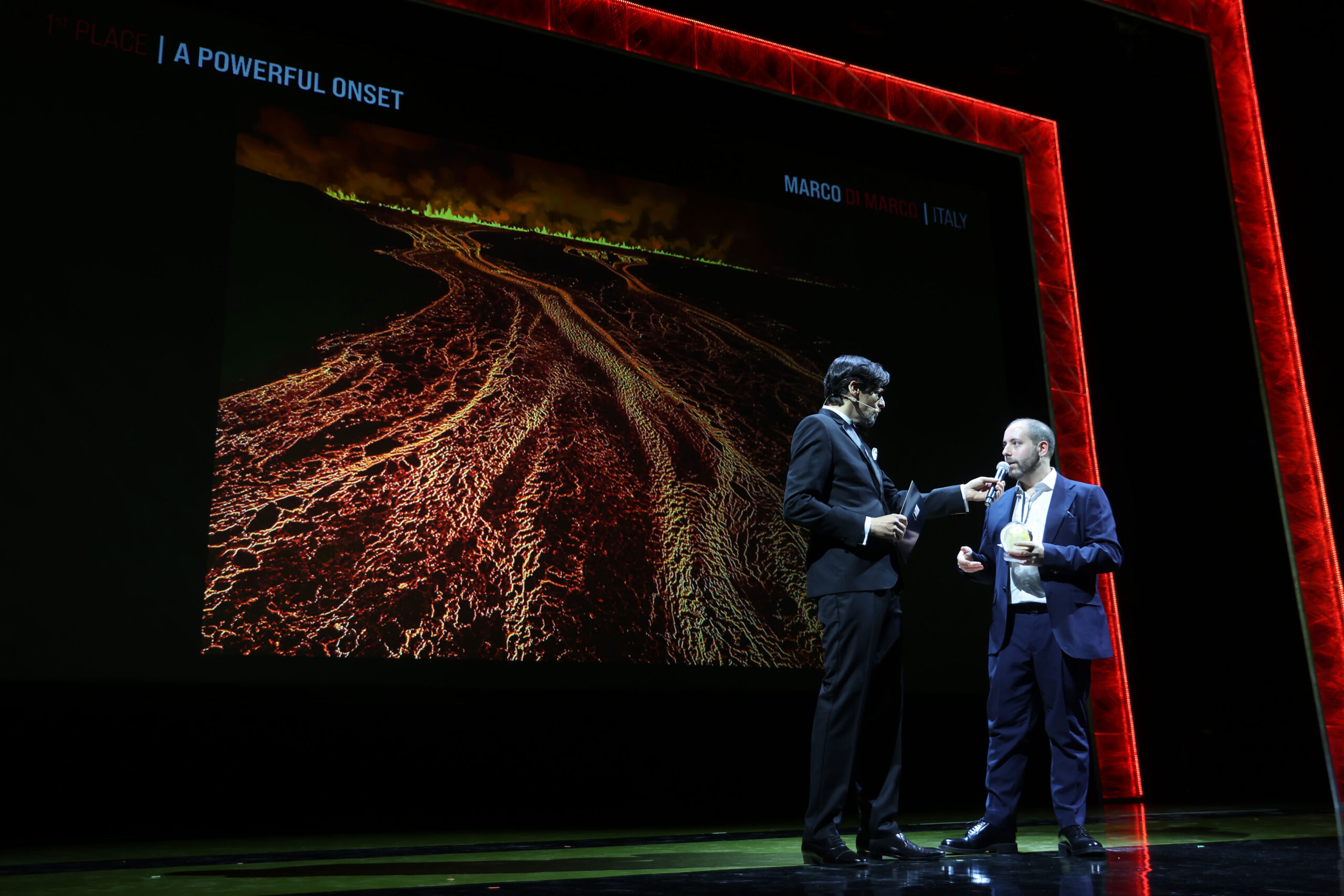
A few seconds before the winner of The Beauty of Nature was formally announced at the Siena International Photo Awards, I had already understood that A Powerful Onset was the photograph they were about to call. I remember that realization much more clearly than what followed.
The next couple of minutes come back to me mostly in fragments. I remember walking into the Teatro dei Rinnovati, crossing the theatre and eventually finding myself on stage, but much of the sequence in between is far less clear.
I had arrived in Siena already extremely happy to be among the ten nominated photographs in the category. It was my first time taking part in the Siena International Photo Awards, and seeing the photograph included in the exhibition was already a significant result. Winning was not something I had seriously considered.
The photograph that brought me there had been made almost two years earlier, during a freezing and very windy night on Iceland’s Reykjanes Peninsula. This is the story of how that photograph came together during the first hours of the eruption, and of the week in Siena that followed almost two years later.
Contents
- The Night Behind A Powerful Onset
- A Chapter in a Longer Volcanic Story
- Siena for the First Time
- More Than the Award
- A Result I Never Expected
The Night Behind A Powerful Onset
The eruption began at 23:14 on November 20, 2024, along the Sundhnúkagígar crater row at Svartsengi Volcanic System, on Iceland’s Reykjanes Peninsula. It was the seventh eruption of the sequence that had started in December 2023.
The opening phase of the Svartsengi eruptions is particularly demanding from an operational point of view. An eruptive fissure a few kilometres long can open in a very short time, with multiple active vents along the same line and lava rapidly emplacing on both sides of the eruptive fissure. At the same time, scientists, Civil Protection, police and the other teams involved are assessing how the event is developing and carrying out aerial monitoring.
For media operators using drones, that means working around those monitoring operations. While helicopters or official monitoring drones are active in the area, our drones stay on the ground. We keep in contact with the operations room by radio, or speak to them directly when necessary, and take off only once we have been cleared to do so. The exact procedure varies between eruptions and often within the same day, depending on the operations taking place.
That night, a section of Grindavíkurvegur, the road connecting Reykjanesbraut with Grindavík, was among the locations journalists and camera crews had been allowed to reach. I worked from there, photographing and filming from the road until we were cleared to fly.
From our position, photographing the active fissure cleanly was difficult. The terrain in that part of the peninsula is relatively flat, and fresh lava was already spreading across the ground between us and the active vents. The heat rising from it created such strong distortion that, especially with a long lens, the fountains in the background appeared almost completely blurred.
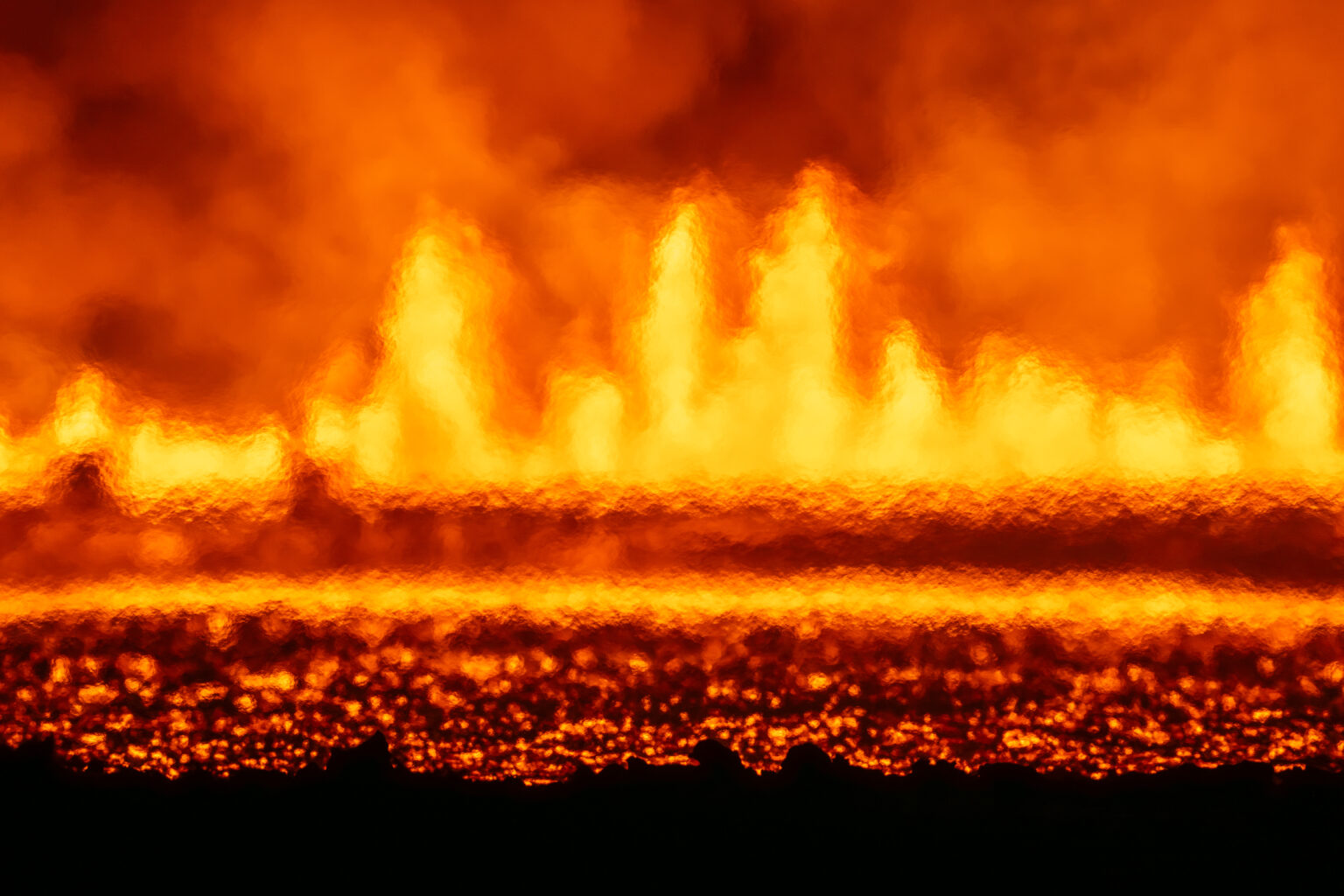
The eruption seen from Grindavíkurvegur during its opening phase. Heat rising from the lava field heavily distorted the view of the active fissure from the ground.
Eventually clearance came and, once the drone was in the air, the view changed completely. Getting above the layer of heat that had been distorting the scene from the road gave me a much cleaner view of both the active fissure and the structure of the lava field.
It was around -9°C and very windy that night. Neither condition made working outside particularly pleasant, but both gave me some additional margin once the drone was directly above the lava. Flying in front of an active flow is one thing, hovering above it is another. The radiant heat can damage a drone very quickly, and even with the cold air and strong wind there was no certainty about how much extra margin I actually had.
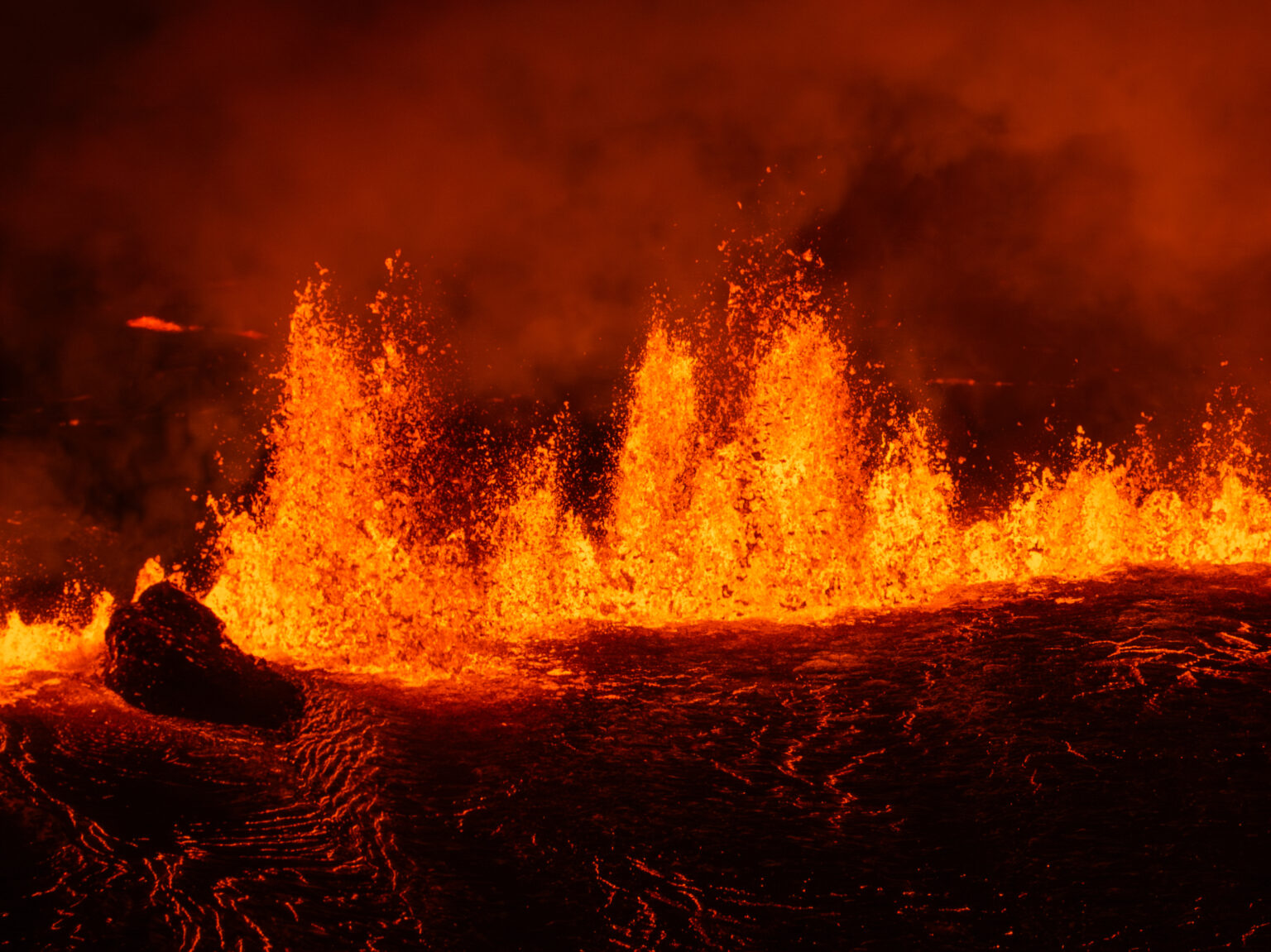
The active fissure seen from the drone. From above, the heat distortion that dominated the view from the road was no longer between the camera and the lava fountains.
I was shooting both photographs and video and looking at different parts of the eruption from above when a pattern in the lava flows between the active fissure and the more distal part of the field caught my attention. From the road I had not perceived it as a possible composition, but from the air several active channels created lines through the field that visually led back towards the fissure.
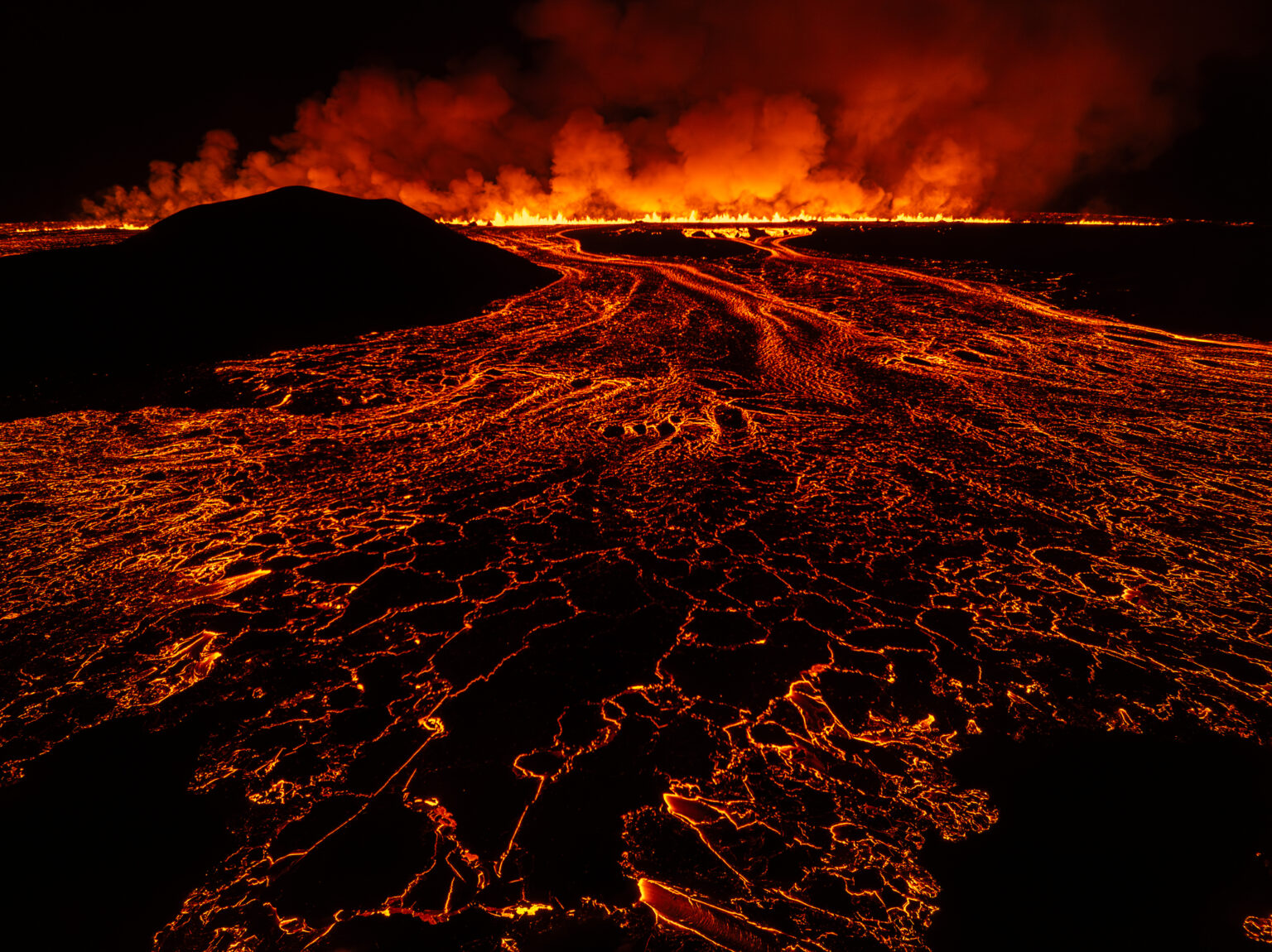
An earlier view of the lava field, with the pattern of the flows that later became central to A Powerful Onset already visible in the middle ground.
I moved the drone into position and spent a short amount of time looking for an angle where those lines worked together. The cold and wind were helping, but there was no way to know exactly how much, so I did not stay over the active lava longer than necessary. I made a few photographs, recorded a few short clips and flew back.
One of those photographs became A Powerful Onset.
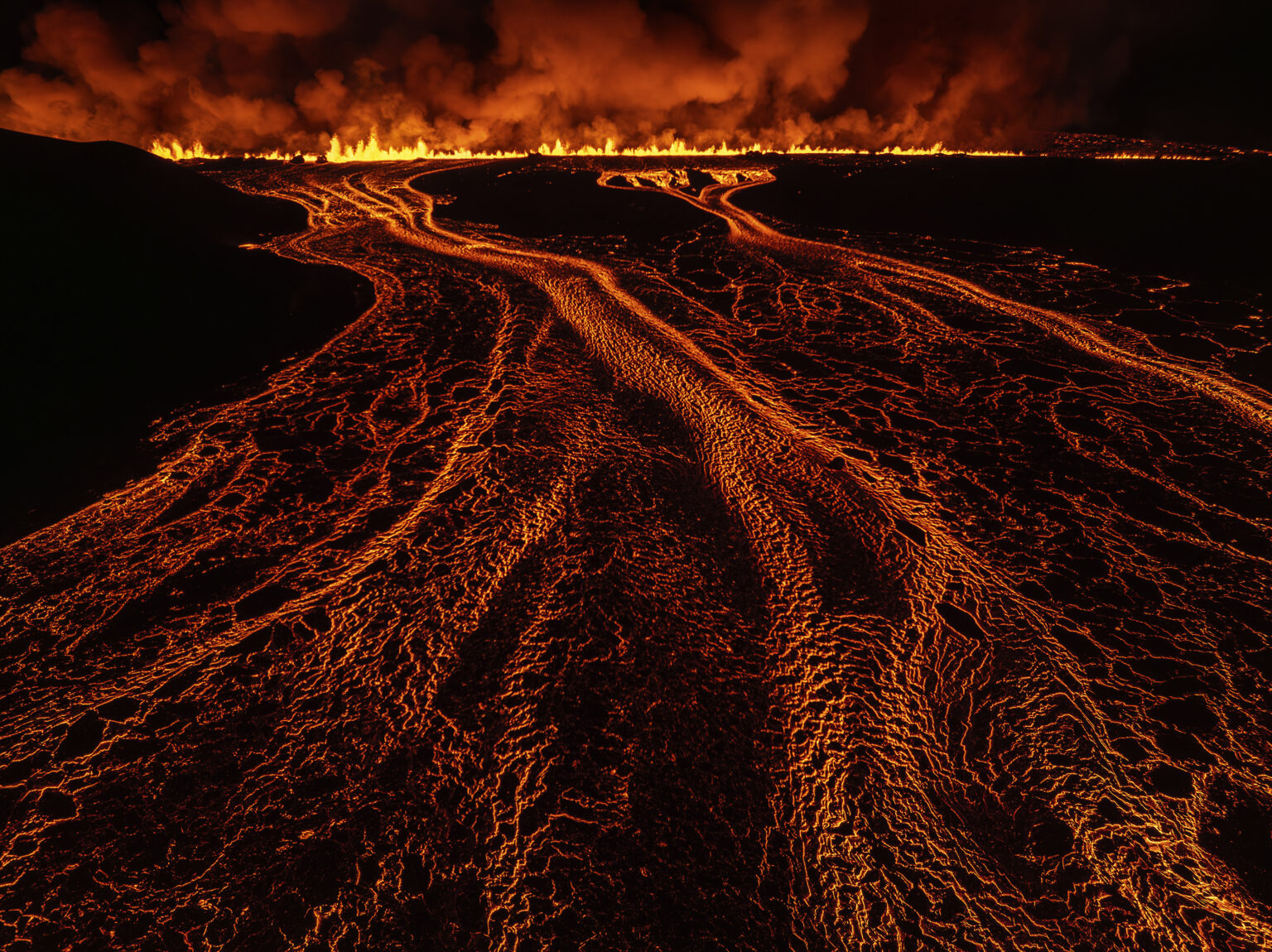
“A Powerful Onset”, photographed during the November 20, 2024 eruption along the Sundhnúkagígar crater row at Svartsengi Volcanic System, Reykjanes Peninsula, Iceland.
That element of discovery is still one of the things I like most about the image. The pattern was not visible in the same way from the road and only became a photograph once I could explore the lava field from above.
A Chapter in a Longer Volcanic Story
I started documenting the Reykjanes eruptions right from the beginning in 2021, when volcanic activity returned to the peninsula at Fagradalsfjall after centuries without an eruption in the area. The first three eruptions at Fagradalsfjall (Geldingadalir, Meradalir and Litli-Hrútur) were accessible to the public and attracted huge numbers of visitors.
My experience around volcanic environments goes much further back than Reykjanes. I grew up around Etna and spent years photographing its activity and working close to eruptions, gas and rapidly changing volcanic conditions. That field experience, together with my university studies, gave me a base that I later adapted to Icelandic volcanic systems, different hazards and a very different operational environment.
The nature of my work on Reykjanes changed significantly when the unrest shifted towards Svartsengi in late 2023. Grindavík was evacuated and a new eruptive sequence began along Sundhnúkagígar, with roads, power infrastructure, defensive barriers and the town itself increasingly becoming part of the story. Since then I have continued documenting the crisis through photography and video, mainly for Associated Press and international media.
Repeatedly working through these eruptions inevitably builds a very specific kind of familiarity, but familiarity does not make each new event predictable. The exact position of the fissure, the direction taken by the lava, wind and gas conditions, which infrastructure may become threatened and where access remains possible all determine both how the eruption develops and how we are able to work around it.
The August 2024 eruption is a good example. Its opening phase was the most intense of the entire sequence, yet the lava did not directly affect major infrastructure in the way it did during other events. Similar starting conditions can therefore lead to very different situations on the ground.
A Powerful Onset has had its own trajectory within this longer body of work. It was included in Associated Press’ 100 Photos of the Year and, earlier in 2026, received the Federation of European Photographers’ Volcano Photography Image of the Year award in Reykjavík, alongside recognition in other international competitions. In October, the same photograph took me to Siena.
Siena for the First Time
Siena had been on my list of places to visit for years. I had travelled through Tuscany a few times and already had a fairly clear visual idea of the city from photographs, documentaries, television and everything else I had seen over the years. I expected to like it, and I still underestimated it.
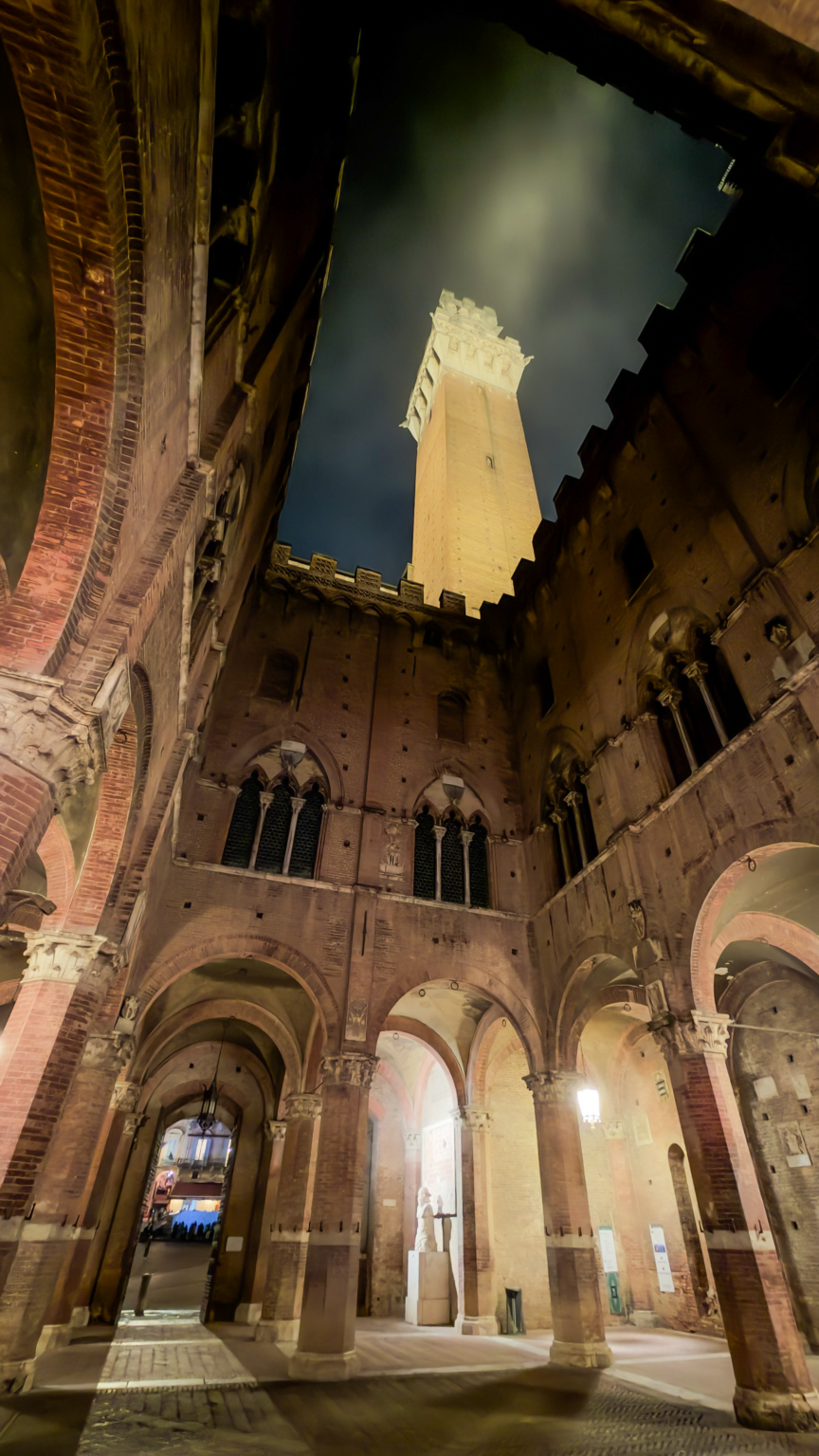
The historic centre has retained an extraordinary connection with its medieval structure. The narrow streets, stairways, brick buildings and colours are already beautiful on their own, but I particularly liked the way small streets and passages suddenly open into much larger spaces. It gives the city a rhythm that is difficult to understand properly until you start walking through it.
We also happened to be there during a weekend when several Contrade were marking the end of their contrada year. For anyone unfamiliar with Siena, the Contrade are the city’s 17 historic districts and communities, closely associated with the Palio but also deeply rooted in the social life of the city. Seeing people moving through the streets with their scarves and colours, with flags hanging throughout the neighbourhoods, added another layer to experiencing Siena for the first time.
And then there was the Duomo, another place I had seen countless times before finally standing in front of it myself.
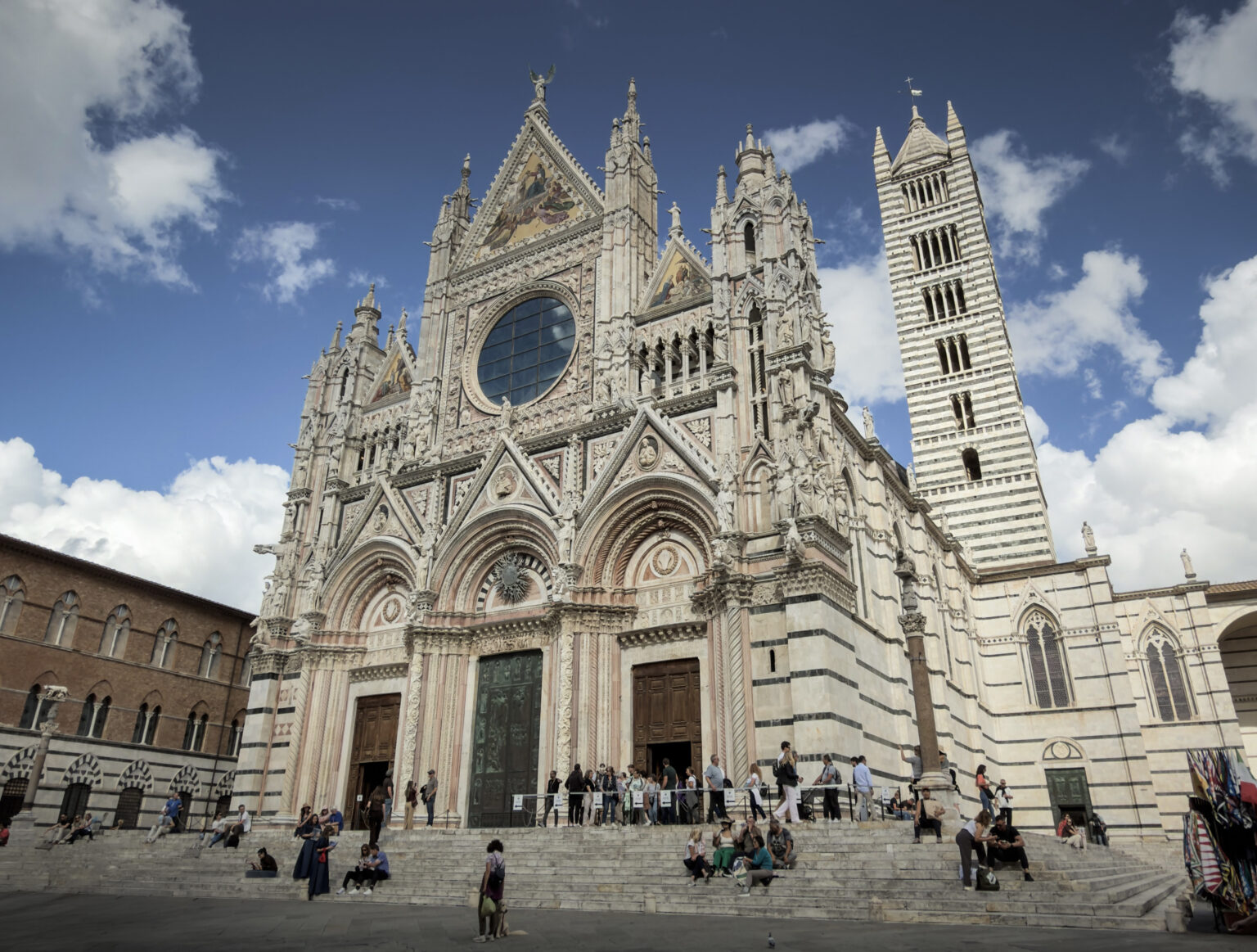
Siena Cathedral.
Seeing Siena for the first time during the same week that A Powerful Onset was being exhibited there made an already long-awaited visit particularly memorable. The People Sharing All the World exhibition at Lo Stellino remains open until November 29, 2026.
More Than the Award
The festival itself gave me much more than I had expected before travelling to Siena, largely because of the people I met there. During those days I got to know photographers from different parts of the world, some whose work I already knew and others I had never met before. We talked about photography, assignments, competitions, places we had worked and, after a while, plenty of things that had very little to do with photography at all.
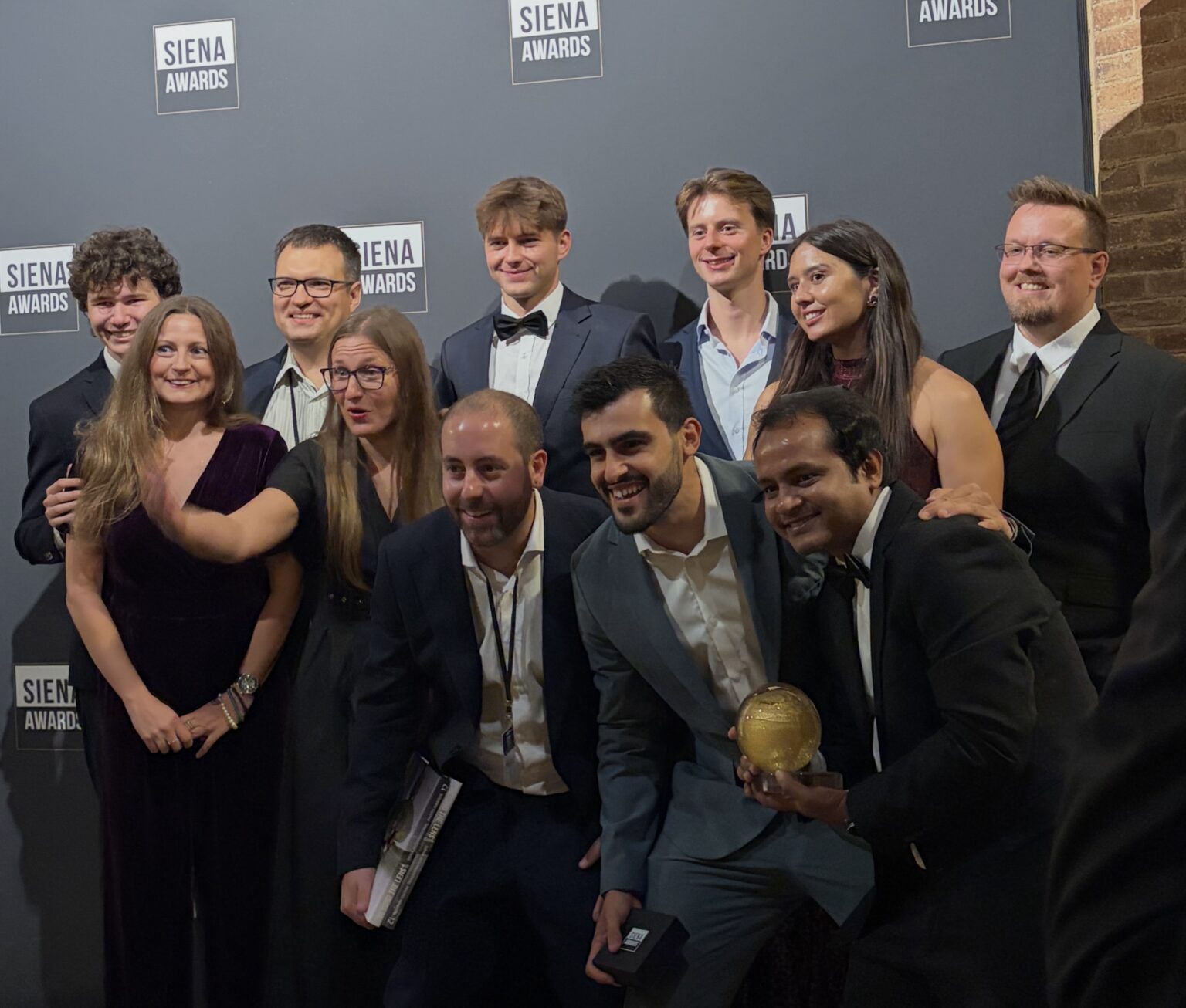
With some of the photographers I had the chance to spend time with during the Siena Awards week.
The way the week was organised helped enormously. There were trips outside Siena, exhibitions, talks, dinners, aperitivi and plenty of informal time together, which meant we actually had the opportunity to get to know one another rather than only crossing paths at the ceremony. The Siena Awards team made us feel genuinely welcome throughout the week, and several of the relationships that started there are ones I hope will continue well beyond the festival.
The talks and exhibitions were another major part of the experience. Hearing Jasper Doest present Meet Bob himself added another layer of depth to a project with an extraordinary story behind it. Andrew Harnik spoke about his work photographing American political power, including inside the White House and the Oval Office, while Carol Guzy presented her work documenting ICE arrests and the families affected by them. Those were two talks I had particularly wanted to hear, and both were among the highlights of the week for me.
James Nachtwey’s Witness to Our Time exhibition in Sovicille was another one. As someone whose work is primarily rooted in visual journalism, seeing such a substantial body of work from one of the photographers who has helped define modern photojournalism was worth the visit on its own.
The morning after the ceremony we went to the exhibition at Lo Stellino, where the awarded photographs were hanging on the walls after we had watched them projected inside the theatre the previous evening. That was where I finally had the chance to spend time looking properly at the other awarded work, meet some of the photographers again and stand in front of A Powerful Onset with the Pangea Prize in my hands.
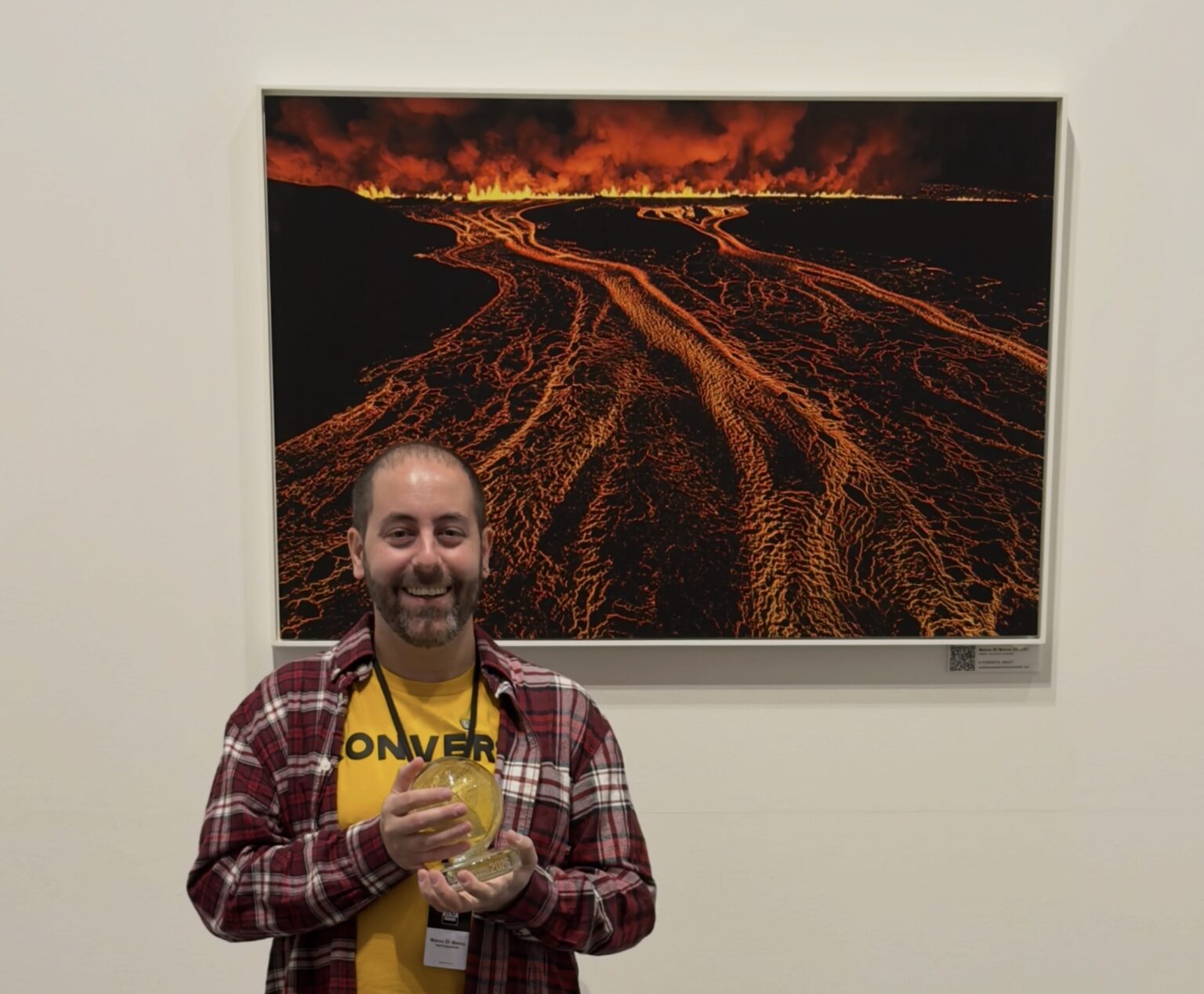
With the Pangea Prize in front of A Powerful Onset at Lo Stellino.
A few people, including fellow photographers, also asked me to sign the page containing A Powerful Onset in their copies of Beyond the Lens, the Siena Awards book, and I did the same with some of the photographers whose work I admire. Signing a book containing one of my own photographs felt truly surreal.
A Result I Never Expected
For years I had followed the Siena International Photo Awards without seriously considering entering. I looked at the work being selected and simply did not think my photography was ready for that level of competition. Over the last few years that perception gradually changed, together with the work itself, and in 2026 I finally decided to submit.
The scale of the event also puts the selection into perspective. Across the three Siena Awards competitions, more than 40,000 photographs from 163 countries were submitted in 2026. Being one of the ten nominees in The Beauty of Nature was already far more than I had expected when I entered and more than enough reason to travel to Siena for the festival.
Being one of this year’s category winners, alongside photographers such as Carol Guzy, a four-time Pulitzer Prize winner and the 2026 World Press Photo of the Year winner, and Saher Alghorra, winner of the 2026 Pulitzer Prize for Breaking News Photography, meant a great deal to me.
When The Beauty of Nature came up during the ceremony, I had already spent several days enjoying the simple fact that I was there as a nominee. Then, a few seconds before the formal announcement, I understood that A Powerful Onset had won and whatever ability I had to process the next few minutes more or less disappeared. I remember the emotion very clearly. The sequence itself is less reliable: walking into the theatre, reaching the stage, Fernando Tiberini, the host, asking me questions, the Pangea Prize in my hands and my photograph on the screen behind us.
Siena Awards 2026 Awards Ceremony. The Beauty of Nature award begins at 1:29:45.
There are professional results that become easier to put into perspective once a few days have passed. This one still feels different.
I also want to thank Luca Venturi, founder of the Siena Awards, the entire team and the jury for the recognition, the work behind the festival and the way they welcomed us throughout the week.
The Pangea Prize is now here with me in Iceland, a long way from Siena and only a relatively short distance from where A Powerful Onset was made. What I will probably remember most clearly in the years ahead is everything that gathered around that photograph: the eruption itself, the decision to finally enter Siena, the moment in the theatre when I realised I had won, and especially the people I met once I got there.
For a photograph made during a few intense minutes above an active lava field on a freezing night in late November in Iceland, it has been quite a journey.
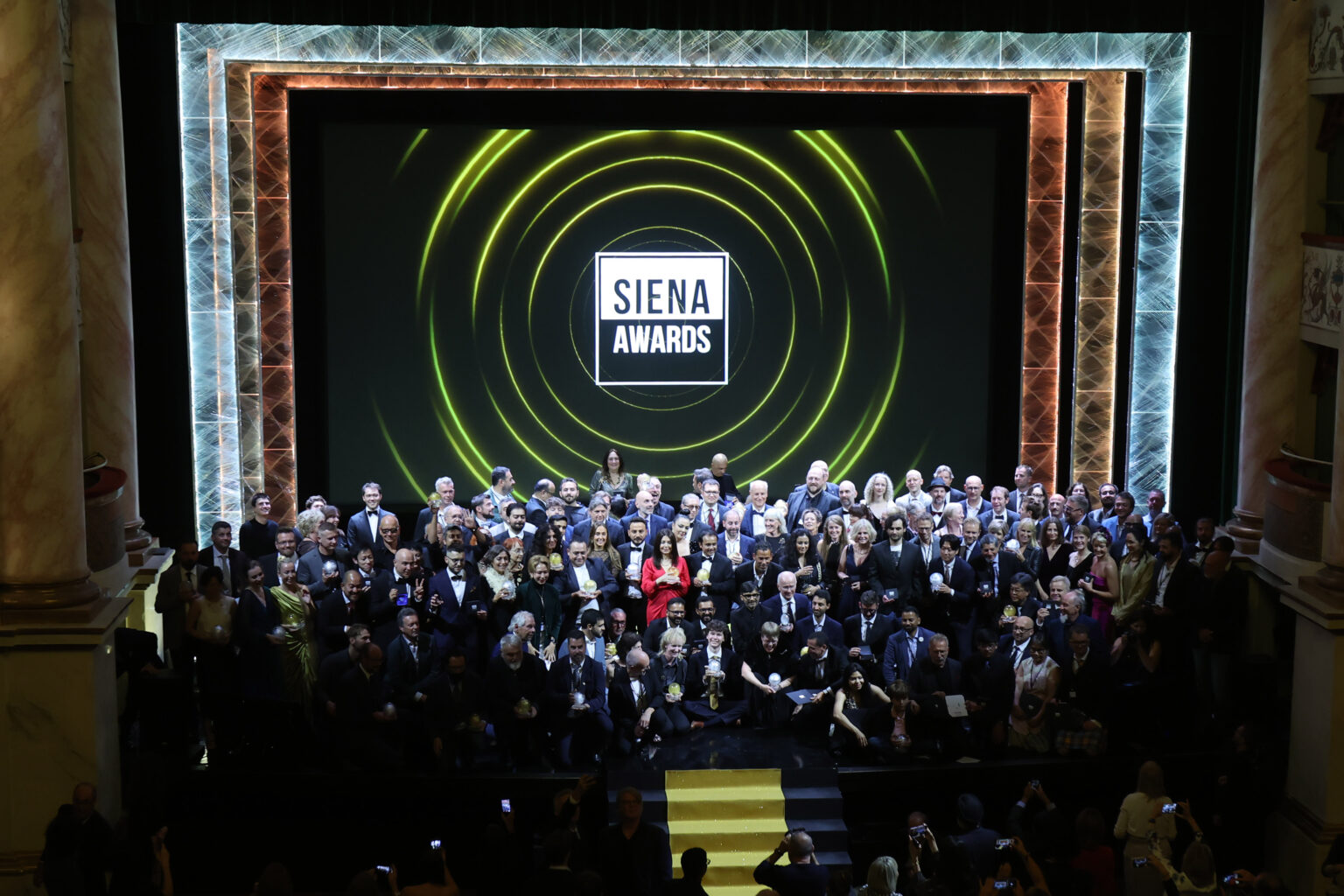
Photographers honoured at the 2026 Siena International Photo Awards ceremony at the Teatro dei Rinnovati. Photo: Fabio Di Pietro / Siena Awards.